

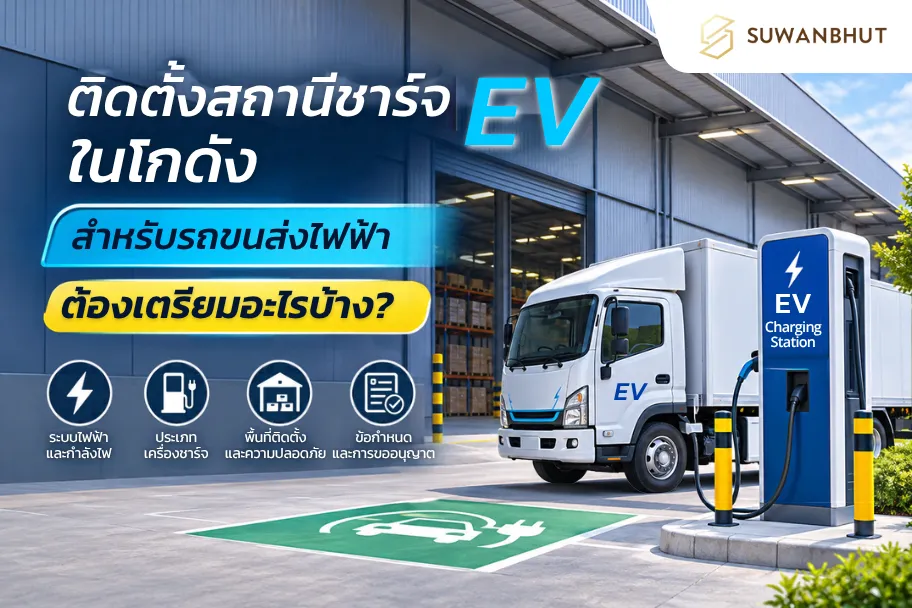
Many businesses are considering electric pickup trucks, electric vans, and electric trucks for deliveries, in order to cut fuel costs and reduce carbon emissions. But the question that follows almost every time is, “So where do we charge them?”
The simplest answer is to charge at your own warehouse or factory. However, installing a charging station is not just a matter of buying a charger and plugging it in. This is especially true for operators looking for a warehouse or factory in the Phraeksa, Bang Phli, and Bang Pu areas. It should be considered before choosing a site, not after moving in. The Suwanbhut Project has therefore compiled guidelines for preparing before installing an EV charging station, to help businesses plan appropriately, reduce duplicated work, and avoid the cost of later modifications.
Note: This article provides general guidance. Requirements and standards for charging stations in Thailand are continuously being developed by the Department of Energy Business (DOEB). Before actual installation, always consult an electrical engineer and check with the local electricity authority (MEA or PEA).
Start by Assessing Your Readiness Before Installing an EV Charger
Before installation, you should understand your usage needs so that you can choose a charger suited to your business.
- The number of electric delivery vehicles needed, and the battery capacity of each vehicle
- The average distance each vehicle travels per day, and the time of day vehicles return to park at the warehouse
- The daily parking duration: whether it is enough for AC charging, or whether a DC fast-charging system is required
- Plans to add more electric delivery vehicles in the future, so that you can prepare appropriately for expanding the charging system
AC vs DC Comparison: Which Suits Delivery Vehicles?
| Criteria | AC charging | DC fast charging |
|---|---|---|
| Speed | Slower; suited to overnight parking | Fast; suited to vehicles that run multiple rounds per day |
| Power required | Lower | Much higher; the electrical system often needs upgrading |
| Equipment and installation cost | Lower | Higher |
| Best for | Vehicles that return to the warehouse in the evening and leave in the morning | Vehicles that need to be ready for use quickly |
For most warehouses where vehicles return and park overnight, starting with several AC connectors is usually more cost-effective than investing in a single DC unit right away. However, this must be calculated according to actual usage.
Example of estimating power demand (for illustration only)
A three-phase AC charger at 400 volts and 32 amps delivers approximately 22 kW (calculated from √3 × 400 × 32). If five vehicles charge at the same time, you need to allow for about 110 kW of additional power on top of what the warehouse already uses, which may exceed what the existing electrical system can handle. Actual figures depend on the vehicle models and chargers selected.
A 9-Point Checklist Before Installing a Charging Station in Your Warehouse
1. Check the readiness of the electrical system
Check whether the electricity meter size, main circuit breaker, and transformer have enough spare capacity for installing chargers. Each type of EV charger has different power requirements. If the existing electrical system is insufficient, you may need to request a larger meter or install an additional transformer. You should also plan for adding more chargers in the future.
2. Contact the local electricity authority
Check whether the warehouse is in the service area of the Metropolitan Electricity Authority (MEA) or the Provincial Electricity Authority (PEA). Ask about the procedure for requesting a larger meter or additional power capacity, as well as the electricity tariff best suited to your use. In particular, a TOU (Time of Use) tariff, which charges different rates at different times of day, may help you manage EV charging costs efficiently.
3. Separate meters or sub-meters for charging
Separating the meter lets you know the electricity cost of your electric vehicles clearly, compare it with fuel costs, and use it as data for carbon reporting to your customers.
4. Plan the parking and charging layout
Consider the vehicle turning radius, entry and exit directions, and the distance from the charging cable to the vehicle’s charging port, and make sure charging points do not obstruct goods-handling routes. There should be a roof or shelter from sun and rain, especially for equipment installed outdoors. When viewing a warehouse in person, walk around the area in front of the warehouse and the parking yard of the unit you are interested in, to see whether there is enough space for vehicles and charging points without obstructing loading and unloading.
5. Protect against flooding and moisture
The electrical cabinet and chargers should be positioned above the water levels that have previously flooded the area. If the warehouse is in a high-risk area, plan for this before design, not after an incident. You should ask the team about the floor level and flood history of the unit you are interested in, so that you can decide the positions of the electrical cabinet and chargers.
6. Electrical safety and fire protection systems
You need a properly installed grounding system, protection devices against earth leakage and surges, suitable wiring and conduits, and positioning away from flammable goods. A licensed electrical engineer should design the system and inspect the finished work, and the warehouse’s insurance company should be informed.
7. Check charger standards and legal requirements
Choose equipment that has certified standards and after-sales service providers in the country. Check that the charging connector fits the vehicles you buy, and ask how installing chargers for the company’s own vehicles differs from opening them to outside parties who charge and pay, because the requirements may differ.
8. Load management and charging schedule
If several vehicles charge at the same time in the evening, it will push up peak demand (Peak Demand) and may cause electricity bills to spike. Staggering charging times, using cheaper tariff periods, or choosing chargers with a load management system will reduce both costs and the need to upgrade the electrical system.
9. Consider solar power and carbon data collection
If the warehouse roof can support solar cells, charging vehicles with self-generated electricity helps cut electricity costs and reduce carbon emissions. Also record the amount of electricity used for charging each month, so you can respond to customers who request carbon data in the supply chain. You should ask whether the roof of the unit you are interested in is suitable for solar installation, and see more energy-saving guidelines for warehouses and factories (in Thai) via the links at the end of the article.
Before Renting a Warehouse: What to Discuss with the Owner
- Is installing chargers, running cables, or requesting a larger meter permitted?
- When the lease ends, who owns the equipment, and does it have to be removed?
- Who is responsible for the cost of upgrading the shared electrical system, if any?
- Are there other tenants sharing the electrical system? This may affect the power available to every unit.
These agreements should be written into the lease from the start. If you have a long-term plan and several electric vehicles, choosing a warehouse that already has an electrical system prepared for this may cost less than modifying an existing warehouse later. Those looking for a warehouse in the Suwanbhut Project can bring these 4 questions to the team as early as the on-site viewing.
Summary: Recommended Sequence
- Determine the number of vehicles, usage patterns, and parking times
- Choose AC or DC to suit actual usage
- Have an engineer assess the power requirement, and ask the electricity authority about requesting additional load and tariff rates
- Design the site layout, safety measures, and flood protection
- Set up sub-metering and data collection
- Install, test, and train the team
Read more (articles in Thai):
- Energy Saving: Save Energy and Increase Profit with Factories and Warehouses in the Suwanbhut Project
- Choose a Warehouse Wisely and Avoid Scams: What to Check Before Buying or Renting
- How to Take Care of a Warehouse After a Flood
Looking for a Warehouse Ready for Electric Vehicles?
The Suwanbhut Project offers ready-built warehouses and factories with offices, starting from 500–1,100 sq m, in Phraeksa, Bang Phli, and Bang Pu, in locations connected to expressways and main roads.
You can tell us the number of electric vehicles, parking times, and the power capacity you plan for, then consult the team at +66 66 164 9988 (066 164 9988) or sales@suwanbhut.com.
Frequently Asked Questions (FAQ) - Installing EV Charging Stations in Warehouses for Electric Transport Vehicles
Q: What should be assessed before installing an EV charging station in a warehouse?
A: Businesses should assess the number of electric vehicles, battery capacity, average daily driving distance, and the time vehicles remain parked at the warehouse. This information helps determine the appropriate charger type and required electrical capacity, while also allowing room for future fleet expansion.
Q: What is the difference between AC and DC EV chargers, and which is more suitable for warehouses?
A: AC chargers have lower power requirements and generally cost less to purchase and install. They are suitable for vehicles that return to the warehouse and charge overnight. DC fast chargers provide faster charging and are ideal for vehicles that need to operate multiple trips per day. However, they require significantly more electrical capacity and may require an electrical system upgrade. For warehouses where vehicles are parked overnight, installing multiple AC charging points may be more cost-effective. The final choice should be based on actual usage requirements.
Q: What electrical infrastructure is required before installing EV chargers in a warehouse?
A: Check whether the existing electricity meter, main circuit breaker, and transformer have sufficient spare capacity to support the chargers. If the existing system is insufficient, an increase in electrical capacity or an additional transformer may be required. It is also important to plan for future expansion and additional charging units.
Q: Do businesses need to contact the electricity authority before installing EV charging stations in a warehouse?
A: Yes. Businesses should contact the relevant electricity authority based on the warehouse location, either the Metropolitan Electricity Authority (MEA) or the Provincial Electricity Authority (PEA). They can provide information about procedures for increasing meter capacity or electrical supply, as well as suitable electricity tariffs. Businesses may also consider the Time of Use (TOU) tariff, which offers different electricity rates depending on the time of day, helping to manage EV charging costs more efficiently.
Q: What should businesses discuss with the property owner before leasing a warehouse for EV charging station installation?
A: Businesses should confirm whether the property owner permits charger installation, electrical wiring modifications, and requests for increased electricity capacity. Other important points include ownership of the charging equipment, removal requirements when the lease ends, responsibility for shared electrical system upgrades, and whether other tenants share the same electrical supply. These agreements should be clearly stated in the lease contract from the beginning.
Q: What safety and space considerations are important when installing EV chargers in a warehouse?
A: Charging stations should be positioned to accommodate vehicle access and turning radius without obstructing loading and unloading areas. Proper grounding systems, electrical leakage protection, and surge protection devices must also be installed. Chargers should be positioned away from flammable goods. A licensed electrical engineer should be appointed to design and inspect the installation before it is put into operation.
Q: How can businesses protect EV charging equipment from flooding in warehouses?
A: Electrical cabinets and charging equipment should be installed above the highest known flood level in the area. For warehouses located in flood-prone areas, flood protection should be considered during the planning and design stages. Businesses should check the warehouse floor elevation and local flood history before deciding where to install the equipment.
Q: How can businesses manage electricity costs from EV charging more efficiently in warehouses?
A: Installing a separate electricity meter or sub-meter for EV charging helps track vehicle charging costs more accurately. Businesses can also schedule charging sessions at different times to avoid peak electricity demand and use chargers with Load Management systems. In addition, using solar energy from Solar Cell installations and recording monthly electricity consumption can help reduce operating costs and provide data for carbon emissions reporting.
Q: How can businesses contact Suwanbhut Project to find a warehouse suitable for EV charging station installation?
A: Suwanbhut Project offers ready-built warehouses and factories with office space, ranging from 500–1,100 sq.m., in Phraeksa, Bang Phli, and Bang Pu. Businesses can share their EV fleet size, parking duration, and planned electrical capacity with our team to discuss the suitability of available spaces. Contact us at 066-164-9988 or email sales@suwanbhut.com for further information.